Most folks who haven't towed a trailer before assume it's harder than it actually is. The truth: if you can drive a pickup or SUV, you can tow one of our trailers. Here's everything you need to know to feel confident behind the wheel with a camper hitched up.
Step 1: Make Sure Your Vehicle Can Tow It
Before anything else, check two numbers:
- Your vehicle's towing capacity — Check the owner's manual or the sticker on your driver's-side door jamb. This is the max weight your vehicle can safely pull.
- The trailer's GVWR (Gross Vehicle Weight Rating) — That's the trailer's max weight when fully loaded with water, gear, and people.
Rule of thumb: Your tow capacity should be at least 20% higher than the trailer's loaded weight. So if our trailer maxes out at 6,500 lbs, your truck or SUV should be rated for at least 7,800 lbs to tow comfortably.
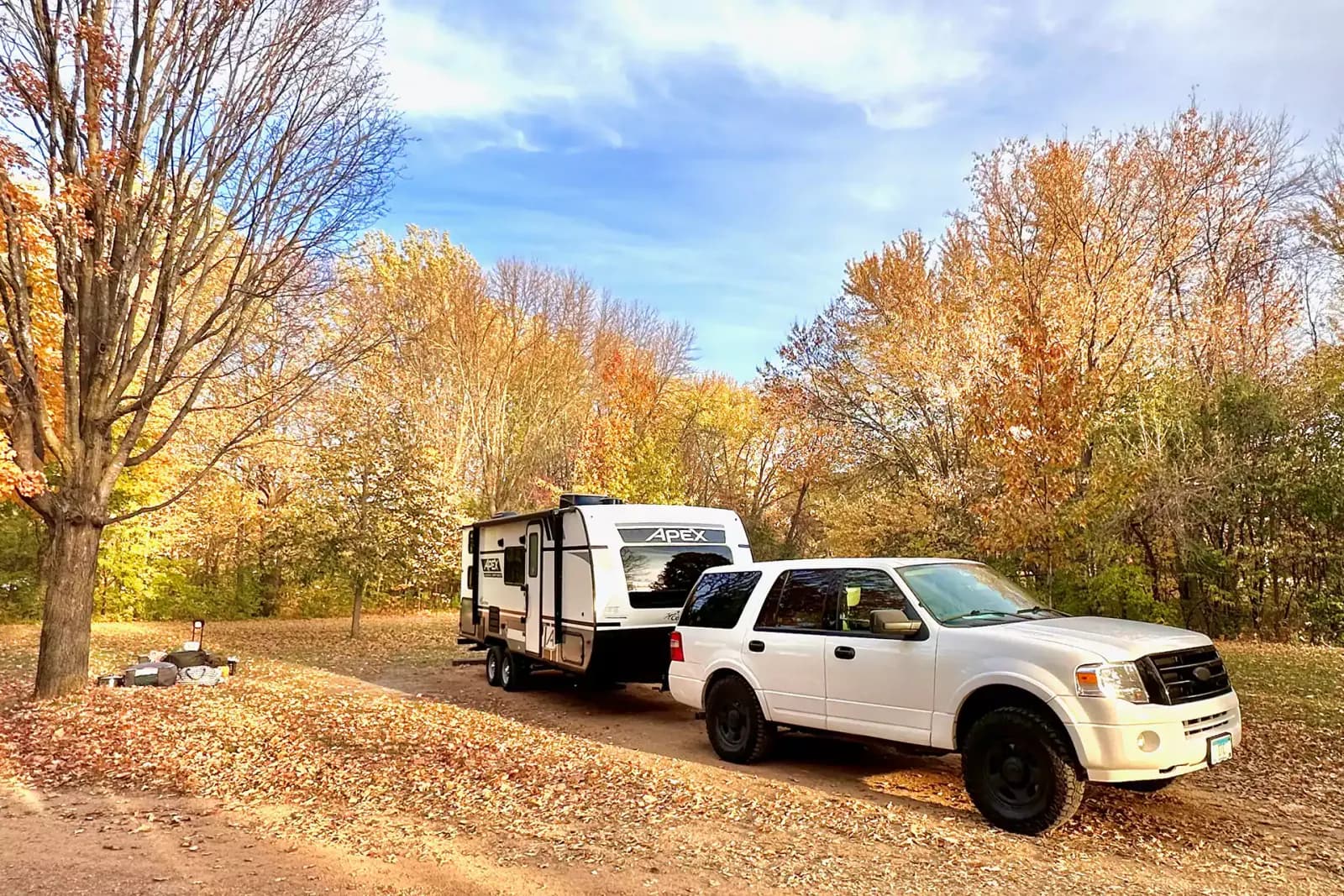
Most half-ton pickups (F-150, Silverado 1500, RAM 1500) and full-size SUVs (Tahoe, Suburban, Expedition) can handle our trailers easily. If you're not sure about your vehicle, send us the year, make, and model — we'll help you figure it out.
Step 2: You Need the Right Hitch Setup
Your tow vehicle needs:
- A receiver hitch — Class III or higher, rated for your trailer's weight
- A weight-distributing hitch (for larger trailers) — Spreads the load evenly so the back of your truck doesn't squat
- A 7-pin connector — Powers the trailer's brakes and lights
- A working brake controller — Lets your trailer's brakes activate when you brake. This is required by law in Minnesota for trailers over 3,000 lbs.
If your vehicle doesn't have a brake controller, we can usually point you to a local installer. It's a 1-2 hour install, and once it's in, you're set for life.
Step 3: Hitching Up
When you pick up the trailer, we walk through this with you, but here's the order:
- 1.Back your tow vehicle up so the ball is roughly under the coupler
- 2.Crank the trailer down onto the ball using the tongue jack
- 3.Lock the coupler (always double-check this — it's the most common mistake)
- 4.Cross the safety chains under the coupler
- 5.Plug in the 7-pin connector
- 6.Attach the break-away cable
- 7.Raise the tongue jack all the way up
- 8.Test the brake lights and turn signals before you pull out
That last step is a big deal. Half the trailers you see broken down on the side of I-94 had a wiring issue that wasn't caught before they left the driveway.
Step 4: Driving with a Trailer
The big differences when you've got a camper behind you:
- Slow down — Take the speed limit minus 10 mph as your max. You'll have better control and use less fuel.
- Wider turns — The trailer cuts the corner sharper than your truck does. Take turns wider than you normally would.
- Longer stopping distance — You're now 7,000+ pounds heavier. Leave WAY more space in front of you.
- Watch for sway — In strong crosswinds or when a semi passes you, the trailer can start swaying. Don't hit the brakes — gently apply the manual brake controller (the lever on the controller itself) to straighten it out.
- Plan your stops — Fuel stops, food stops, anywhere you'd normally pull in. You need pull-through spots wherever possible. Truck stops are your friend.
- Use the right lane on highways — Stay out of the fast lane. You're not in a rush, and trucks won't tailgate you on the right.
Step 5: Backing Into a Campsite
This is where most first-timers get nervous. Here's the secret:
- Get out and look first. Walk the site. See where the picnic table, fire ring, hookups, and trees are. Make a plan.
- Hand on the bottom of the steering wheel. When backing up, whichever way you move your hand, that's the way the trailer goes. It feels backwards to your normal steering — that's because it is.
- Small movements. Tiny adjustments. If you crank the wheel hard, the trailer jackknifes fast.
- Use a spotter. Have someone outside guiding you with hand signals or walkie-talkies. Phone calls work fine if you don't have radios.
- Pull forward to reset. If your angle gets weird, just pull forward and start over. There's no penalty for taking three tries.
Within a week of doing this, you'll be backing into sites like you've done it your whole life.
A Few Things NOT to Do
- Don't speed. Trailer tires are rated for a max speed (usually 65-75 mph). Going faster than that builds heat and blows tires.
- Don't pull out without checking your mirrors AND the safety pin in the coupler. This is the #1 cause of trailers separating from tow vehicles.
- Don't forget about your overall height. Most of our trailers are around 10'6" tall. Watch for low bridges and gas station awnings.
- Don't drive distracted. Towing requires more focus than regular driving. Save the texting for the campsite.
When to Call Us
If anything feels wrong — weird sound, sway you can't control, smoke from a wheel — pull over safely and call us. We'd rather drive out and help than have you push through and damage the trailer (or yourself).
You've got this. Take your time, double-check everything, and enjoy the drive.